

When you think of art, I want you to think of service and joy
The calling of a writer is nothing less than prophecy

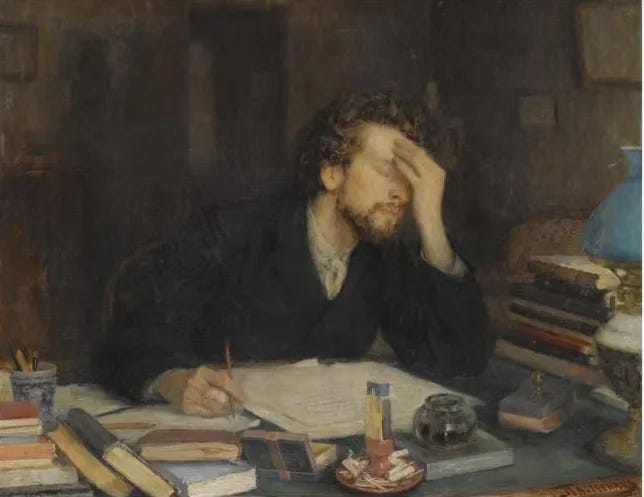
“There is a world inside your soul
Of mystical, enchanted thoughts…”
- Tiutchev
An Essay by Ivan Ilyin, dedicated to Sergei Rachmaninoff
Art is service and joy. An artist who creates and makes serves in order to call us all into fellow service with himself. The joy of an artist, who creates and has created in his works a new manner of living, is to gift us, who are able to contemplate, an unspeakable joy.
Do people understand this? Do the nations, restless and tempted in spiritual troubles, remember this fact? Do they even know what is service and joy?
Joy…
Joy is not accessible to everyone. Modern man doesn’t seek it. It is born from suffering and overcoming that suffering. Not from boredom that requires diversion. Not from an empty soul that doesn’t know how to fill up its emptiness. Not from exhaustion and overwork that requires perpetually new irritants and evanescent poignancy.
Modern mankind, both the masses and the so-called elite, only know how to overwork themselves, how to bore themselves, and how to suffer from inner emptiness. This is exactly why everyone thirsts for action, diversion, and arousal. People want noise. They want things to crack and smash. They want their nervous systems to be tickled. They require things to arouse them. Not only from the pharmacist, but also from the artist.
Too many artists—they are, after all, children of the age—are ready to meet mankind halfway. So many invent “new art” from the dry source of utterly exhausted souls. They strive to break through to new, sharp sensations, so that they can then share those sensations with the public. Modern art is full of spiritual irritation and willful invention.
Who, in our time, thinks of the beautiful? Who thinks of the song that comes from deep within? Who thinks of the inspiration that comes from temperance, of great visions? Where is there a place in our time for joy?
Joy shines and sings forth. But modern man, in his modern art, only mocks, laughs, and growls. He needs bread and circuses, not spiritual joy. He wants football, parades, races, and boxing. This is the proper “art” for modern man.
Joy comes from spiritual depths. You have to suffer to reach those depths, overcome the suffering, and be illumined by the struggle. But modern art hurls every new quirk and every bit of new nonsense, put together slap-dash (according to the principle of universal tolerance) from bits of stuff and from spiritual chaos.
Joy is a spiritual state. It comes from the heavens and from God. The voices of Schiller and Beethoven in his ninth symphony have never, and will never, be silent:
“Joy, the spark of the divine
The beauteous daughter of the heavens…”
“What?” says modern man. “That’s just a metaphor. You’re exaggerating!”
No. This is the simple and exact truth.
“…But aren’t you ‘dethroning’ God and ‘stealing’ heaven’s thunder?”
And now, a black hurricane storms over the earth. It will teach you how to snicker and to growl. It will make you completely forget how to laugh and how to enjoy yourself…But at least it will teach you or your children to cry out from their depths, to spiritually suffer, and to spiritually overcome.
And then joyful artists of joy will again come to be—and they do exist in our time, and they do create, but you hurry past them to your bazaars of tastelessness, to purchase your favorite noisy travesties.
Service…
Everything great in art is born in service. A free and willing bondage, for it is born of inspiration. Not from servitude and slavish “commissions.” And not from any base servility before today’s bored neurotics who fill the salons, restaurants, dance clubs, and the columns of the “literati.” Not servility, but service.
A true artist cannot always create. He does not tyrannize his muse. His inspiration will invariably leave him, only to come back again. However, when he is inspired, he knows that he is in a position of a supplicant. He is called, one of the elect. A divine utterance has touched his keen hearing. Since he is called and summoned, he feels himself to be before a Presence. And when he stands before this Presence, he doesn’t see many different possibilities, off them that dependent on his own arbitrary will. He sees only a single creative necessity, which he must seek and find. This seeking and finding is his service.
By creating, he sees. He sees with the eyes of the spirit that open only in inspiration. He creates from a certain inner, spiritual self-evidence. It commands him, but he has no authority over it. This is exactly why creativity is not a free act. To bring your own willfulness into the creative act—to cater to the market, to “prevailing tastes,” or to lewdness—is to preclude service, which is a kind of “creative conscience.”
Do not ask what is the Presence that the artist serves…
The great Russian poets have already answered this question, but few believed them. Everyone thought: “They’re speaking in allegories, metaphors, poetic exaggeration…” And yet they spoke plainly—Zhukovsky and Pushkin and Baratynskii and Yazykov and Tiutchev and many others. And they all said that the calling of an artist is prophecy. Not in the sense that he “foretells the future” or even “exposes the sins of people” in the Biblical sense (though perhaps he does this as well). Rather, through him, the divinely-created essence of the world and human nature itself speaks forth.
This is the presence before which the artist stands as at prayer, for it is a living mystery of God. This is what he serves, becoming its living instrument. Its breath is inspiration. The artist hears its song about itself—this is true of the musician, but also the poet, the painter, the sculptor…
The artist has a deep place in his soul where this mysterious content is born and carried, as in a womb…
“There is a world inside your soul
Of mystical, enchanted thoughts…”
In order to reveal this world inside the soul, the writer needs to cultivate a life of creative and spiritual practice. Find out how in my video series on Cultivating the Life of a Writer:
This deep place is usually covered in opaque darkness, not only for others, but for the artist as well. Often, the artist himself doesn’t know or realize this. He doesn’t recognize what has come to life, what grows and develops in this creative, profound darkness. But when he speaks that which has come to fruition, then that most important thing that he utters—that prophetic excerpt of cosmic meaning, for which everything creative is created—manifests itself in a secret way.
It hides behind musical composition. It is present in the sounds; it fills them with meaning. It sighs and groans in them, inspiring their performance in a similar way to how it had originally inspired the artist-composer.
It also hides behind the poetic utterance, sparkling through it and from it. It pours itself forth in the chosen and unchangeable words of poetry, powerfully scanning the rhythm, powerfully ending the line with a rhyme.
It also hides behind a picturesque painting, behind the strokes of the brush, behind the paints, behind the imagery that it has itself required of the artist and chosen for him.
Ask any artist—what is this that you have created? A true artist will say, strictly and coldly, “Look!” or “Listen!” For he has created his creation so that through it he will say, in it he will place, behind it he will hide, and through it he will reveal—the most Important. Did you look and did you listen to his creation? And after this, you still ask what it is? That means that the mystery of incarnation, the prophecy, did not occur.
This is either the fault of the artist, the ignorance of the listener, or both at the same time. But don’t expect the artist to explain in everyday language, using hackneyed words, that which you were not able to hear in the prophetic utterance of his work of art.
What the artist gives people is not just noise or just words or just pretty pictures drown in lines and paints. If he did, there would be no point in art. Diversions, “fun,” and spectacles would be enough. Not only that, but art could never have come to exist in such a world.
What an artist gives people is first and foremost a certain profound, mystical thought about the world, man, and God. About the paths of God and the fate of man and the world. The artist offers people a kind of “focused meditation,” revealed and unfolded in his melody, his sonata, his sonnet, his poem, his play, or his painting. He offers people the chance to accept his meditation, his mystical thought, to infuse it into their own spiritual treasure house and to find sustenance in it.
A true artists has suffered in spirit, then created. He suffered not only for himself and created not only for himself, but for others. For everyone. And so, he bore his creation like a babe in the womb and was illumined by it. He created. Through him that “most important thing” spoke itself. And through it, he himself was healed and became wiser. He created a new kind of life. A new path to spiritual healing and spiritual wisdom.
And this is what he offers to all who suffer and rush about, blind in their own busyness…
An artist does not just utter prophecy. He is given the authority to imbue human souls with new creative meditations, thereby renewing them. He created new life within them. This authority is his service and his joy.
But this is the spiritual disease of our time. People hear art with spiritually deaf ears. They look at art with spiritually blind eyes. Therefore, all they see in art is a sensual mirage. And they become accustomed to associate it with their own “fun,” their own diversion. Those who are not sick with this disease are lonely, standing in the middle of the noise of your bazaars of tastelessness.
It is still in our power to stand underneath the banner of true, inspired, undefeated, undying, classical, yet prophetic art. We must stand with unshakeable certitude that all historical storms and suffering will only serve to cleanse our spiritual impurity and to clear the spiritual air. In art, as in all things, there are many wrong paths and many temptations. But there is only one true way.
Great art will always be, as it always was, service and joy.