

Before You Can Write a Hero, You Need a Mentor
The unexpected stories that will help you design your hero's perfect mentor figure

For the past twenty years, anti-heroes were ascendant. The almost child-like enjoyment of traditional fairy-tale heroism that we got with the original Star Wars trilogy gave way to the torturous path of Anakin Skywalker to the dark side. Then came grimdark everything, along with that genre’s preferred protagonist: the tortured killer who is trying to make good, but keeps failing because the world is so terrible.
And so is he.
Even the slightly more heroic treatments of this sort of main character treated the very idea of heroism as something either accidental or ultimately doomed or actually not heroic at all. I’m thinking in particular of Joe Abercrombie’s approach to heroism or any of the many versions of dark heroism you see in the Warhammer universe.
But recently, the ironic approach to the traditional hero is starting to grate. Even the people who are good at it (James Gunn) can’t seem to do it well anymore. Supergirl is a particularly bad example of this. The energy for the ironic, snarky, I-know-more-than-you-stupid-people hero or heroine is gone out of the room.
It seems that we may be coming back to a market and a reading public that are ready for more traditional takes on heroism, a point I made in last week’s post about Aragorn as a model for the modern hero.
But before we can describe what contemporary writers should be doing to craft their perfect new-but-classic hero, we need to consider the question of the mentor.
Is the Mentor a Cliche or an Archetype?
If you’re writing a fantasy or a myth (in the generic sense), then you won’t be able to avoid one archetypal step of the heroic quest–the encounter with a mentor. Trouble is, most mentors in fantasy novels these days look and feel like Gandalf. The reason isn’t that writers have no originality. It’s that most of us modern people have not really had mentors as our heroes must have.
So instead of writing into an archetype (which is at least partially connected with the author’s own experience of how the world works), too often cliche becomes the automatic haven for the writer. Or its mirror image–the anti-mentor who is basically the inverse of Gandalf in all things. Again, Joe Abercrombie does this very well in First Law by essentially making the mentor the secret villain of the whole series.
So what are we left with if most examples of contemporary fiction are not good enough, and we are not lucky enough to have had a mentor in our own lives?
Let me suggest the wisdom of Russian fairy tales.
What We Can Learn from Russian Fairy Tales about Finding a Mentor
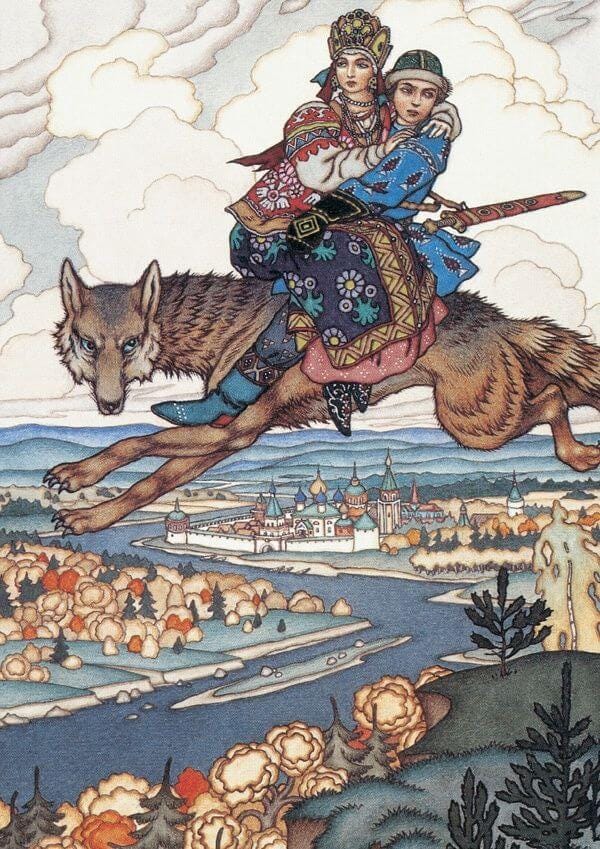
The Tale of Prince Ivan and the Grey Wolf
In Prince Ivan and the Grey Wolf, Ivan goes out into the wild to find the firebird for his father. He falls asleep, and when he awakens, his horse is gone. Ivan searches and searches for the horse, and finally, he finds the horse’s bones. Ivan is very sad, and he continues on foot until he is utterly exhausted, at which point he sits on a log and begins to weep. At this point, a wolf appears and asks Ivan why he is weeping. Ivan explains he has no horse. The wolf confesses he ate the horse and promises to aid Ivan in his quest to find the firebird. The wolf becomes a great ally and mentor.
The takeaway?
Very often, it is not you who finds the mentor; it is the mentor who finds you.
That does not mean we should sit around and wait for a mentor to appear. Notice what Ivan did: first, he did everything he could to pursue his quest until he became utterly exhausted. Then, he wept. This is a symbolic gesture in stories that almost always indicates an abandonment of one’s own desires in order to obtain the object of the quest by any means necessary.
And it is at that point that the mentor always comes.
What does this mean for the writer?
It means that, without the right disposition of the heart, without humility, without an abdication of the will and its desires, even if our main character were to encounter a mentor who might be helpful to him, he might not be able to recognize and take advantage of what that mentor could offer him.
What happens if the main character doesn’t have this humility? Well, he messes up. And that’s exactly what happens to Ivan. The wolf gives Ivan extremely specific instructions, and Ivan cannot fully follow them because he has not fully released his own will. And so, Ivan ends up in prison. You see, when Ivan met the wolf, he had reached a point where he was ready to abandon everything, but his heart was not yet ready to accept the teachings of his mentor. Unfortunately, most of us don’t listen very well until we go through the difficulty of failing.
So this is the first thing we need to remember when we’re designing a mentor for our hero: don’t be too quick to introduce him. And have his appearance be connected with some kind of traumatic or pivotal moment in the main character’s desire line or journey.
The Flying Ship
The second thing we need to remember is illustrated by another fairy tale, “The Flying Ship.” Here’s the story:
An old man and an old woman have three sons. The first two are smart and very capable, and the third is an idiot. (This is a trope, and, of course, the idiot is not really an idiot.) The king of the land issues a decree that whoever can build him a flying ship may marry the princess. So the first two sons get their parents’ permission to go off into the forest, fell a bunch of trees, and try to build this ship. (They have no idea how to build a ship, much less a flying one!). Suddenly, an old man appears to them and asks what they’re doing. They tell him to get lost. They give up on the project, get drunk, and head home.
So the third son, Ivan the Idiot, decides to try his hand at building the ship. He finds his brothers’ felled trees and starts putting them together. The old man pops up again, and Ivan invites him to share his food. They sup together, and the old man tells Ivan how to proceed with the ship. And suddenly, the idiot builds the flying ship!
Now, that’s only the beginning of the story. The set up is, of course, that those who believe themselves to be intelligent end up being the fools, and the one who believes himself to be the fool ends up being intelligent. Or, as Michael Hyatt says, “Don’t believe everything you think.”
All ancient wisdom traditions tell us not to trust ourselves, not to consider ourselves intelligent, and not to assume we’re able to govern ourselves. We need to remember we don’t have the answers.
So what does this have to do with designing a mentor for our heroes?
Sometimes, mentors don’t look the part. In fact, there’s good reason to have your mentor look anything but the part. If you haven’t watched the Russian movie “The Island”, it’s a perfect example of this. As seen repeatedly in the Orthodox tradition, it’s often the one who voluntarily assumes a posture of foolishness who is secretly hiding wisdom.
In other words, consider a holy fool for your mentor. Or one who uses foolishness as part of his arsenal. This is what I did for the my mentor figure in my first novel The Song of the Sirin and my latest novel The Son of the Deathless.
And let me tell you: these characters resonate very strongly with readers.
(By the way, if you’d like to hear me tell the entire story of the Flying Ship, here it is:
The Feather of Finist the Bright Falcon
What if you have a heroine, not a hero? There’s a different traditional structure for the mentor figure in heroine’s quests.
Let me draw your attention to one more fairy tale: “The Feather of Finist the Bright Falcon.” In this tale, a young woman is in love with a falcon who turns into a young warrior in the evenings and visits her in her room. Her sisters grow jealous and put knives in her windowsill. The young woman awakes to see the knives dripping with blood. She weeps bitterly, waiting and hoping, but her falcon does not return.
Finally, she asks her father for a blessing to go out into the world. She orders three pairs of metal shoes, three metal staffs, three metal hats, and three metal loaves of bread, and then she sets off in the direction the falcon flew away. She walks and she walks. Her first shoes, staff, and hat are all worn through, and she has eaten the first loaf of metal bread. Yet she continues to walk until she sees a hut on chicken feet that spins around on itself. Of course, this is the hut of Baba Yaga!
Now, Baba Yaga is usually trouble, but in this case, she is nothing but helpful to our young heroine. Why? What is it about this young woman that makes a known villain suddenly so helpful?
The answer is that unlooked-for help comes to those who suffer.
(Yes, I’m aware of this meme–we Russians do tend to impose suffering upon ourselves:
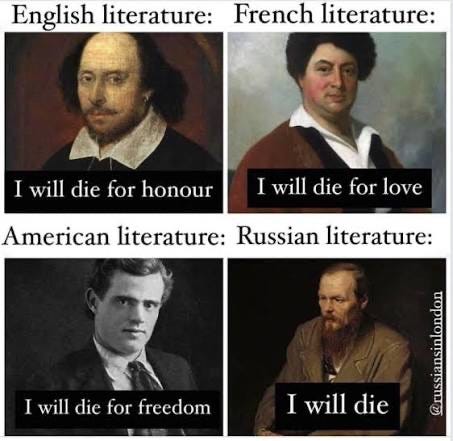
Regardless, it is true that those who suffer often emerge having acquired wisdom.
This is also often the pattern for heroine journeys. The mentor comes late in the story, after a great deal of disasters have already struck the heroine.
What this kind of crone figure offers the hero or heroine is passage from the world of suffering to the world of magic that can only happen as a result of suffering having essentially forced the main character to painfully shed a few snakeskins. The help of this mentor is short-lived and does not constitute the kind of mentor-mentee relationship that persists throughout the journey as it does in heroic quests.
Putting it all Together
These three stories offer a few starting points for how the oldest stories in Russia’s tradition treat the question of the mentor for the hero.
The mentor often appears at an unexpected moment, after the hero has had his first experience of failure. This mentor accompanies the hero on the journey and offers help, but the hero in this paradigm is unworthy of the help and keeps failing, until he finally gains wisdom and heroism at the end of the story.
The obviously wise and sage mentor with a long beard is a cliche. The “wise fool” of old fairy tales is an archetype. And it’s an element that more authors should try out as they design their mentor figure.
Heroine’s stories can often lack the kind of persistent mentor that hero stories need. A short, intense experience of a wild crone at the end of a series of personally devastating disasters can be a very effective way of moving your main character into the heroic stance that is necessary to overcome the villain and bring the story to its satisfactory ending.
What about you? Who are your favorite traditional or non-traditional mentor figures from literature? Do they fit any of the three Russian fairy tale archetypes?
It's like you're reading my drafts! I've been re-working my knight-mentor for a month and he wasn't working the way I wanted. I also have a crazy hermit with too small a role, so I'm going to play with him instead. Thanks for the advice!
This is great!