


Earlier this year, I interviewed Joel J Miller at the St. Basil Writers' Workshop live summit, Spiritual Renewal and the Creative Life. Please enjoy this transcript of our interview.
Dn. Nicholas Kotar: Joel, you talk about the written word in a way that most creatives won’t: in your recent book The Idea Machine: How Books Built Our World and Shape Our Future, you take an engineering approach to language, using things like x, y, and z axes. You talk about books as a technology that changed the world. Our focus in today’s summit is how to renew humanity through the creative act; I want you to be in on this conversation because, as writers and readers, you’re helping us think of the book as an incredible technology that will do the thing I claim we can do.
It’s a huge endeavor to write the history of the printed book, especially because you’re considering not only the historical realities of how the printed book came to be, but also how it impacted society through its various stages. What kind of madness prompted you to undertake a project of this size?
Joel Miller: It is a little bit mad, and it took over ten years to execute. It was a book titled Eyewitness to Jesus that started the whole thing. The idea of the book was that it might be possible to redate The Book of Matthew to about 54 A.D., which is much earlier than most scholars believe to be the case. It turns out that nobody buys that thesis except the author. Nonetheless, it captivated me because it explains things like the origin of the codex, the Christian use of the codex, and other things that ended up becoming obsessions for me.
In 2012, I started thinking about expressive individualism and what I began to think of as the great heresy. I put a book proposal together about the Christian origins of individualism; people talk about individualism as an alien worldview that’s imposed upon us, but it actually extends out of the Christian expression of appreciation for the individual and the individual’s responsibility before God; you can find shimmers of this in the Psalms and elsewhere in Scripture. I put together what I thought was a brilliant book proposal. I was in publishing at the time and thought it would absolutely work. But it was rejected by everybody under the sun. I retooled it, pitched it again, and was rejected again.
But both times I pitched it, editors came back and said they really liked the particular chapter on the impact of the book during the early modern period, particularly during the reformation, because the reformation would not have happened without books. So I thought about expanding that chapter into a book and assumed I could knock it out in a couple of years.
It took ten years because I had to immerse myself in book history. I had to understand not only what made the book unique, but also what I could say about it that hadn’t been said before. What helped me was reading the conversion story in Augustine’s Confessions. Augustine recounts how he is tormented and leaves his friend to go weep in private in the garden, leaving behind him a copy of St. Paul’s letters–the codex–setting it down on the bench. As he wanders off, he hears what he thinks are children saying, “Tole lege,” translated as “Take up and read.” Remembering his book, Augustine runs back to it, opens it at random, and lands on a passage that salves his troubled spirit.
To me, the most interesting thing about that passage is what he does next: he puts his finger, or some kind of marker, in the book. The dots connected in my mind at that moment because I realized Augustine wasn’t talking anymore about the “software,” if you will, of the contents of the book, but rather the “hardware” of the book and what that hardware made possible. The hardware was his ability to find that same passage again to share it with his friend. You can extrapolate from there that he was able to mark any book he owned. If you read, for instance, The City of God, it’s almost like a biography of other books. It’s Augustine interacting with hundreds of other authors. He was marking books, making observations, and drawing connections.
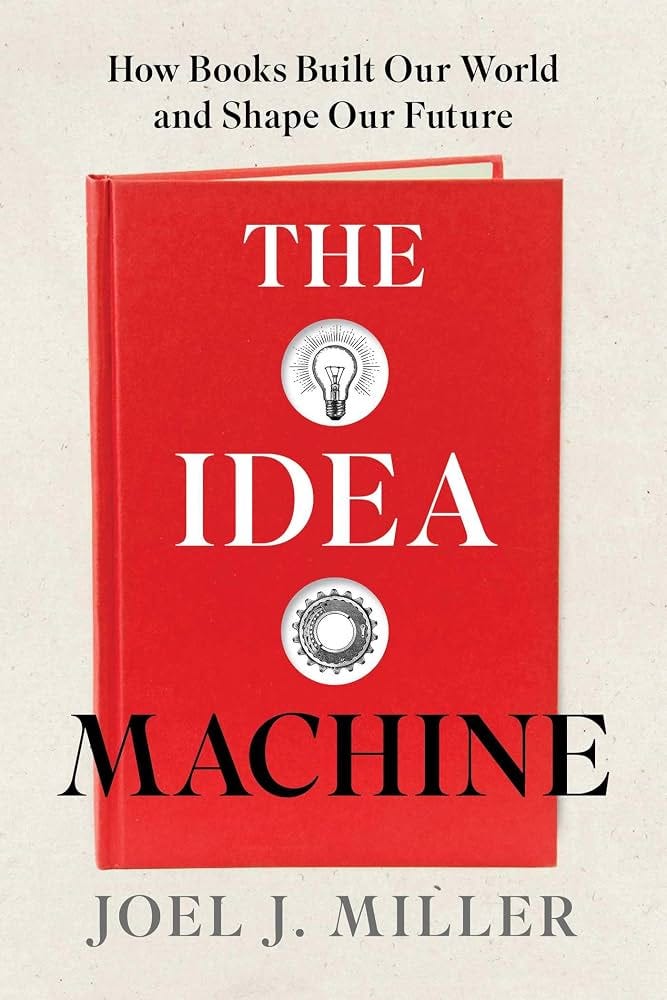
What occurred to me is that it’s the technology of the book that makes this interaction with ideas possible. That’s the inspiration for The Idea Machine.
DNK: You begin by making a point about the form of the book itself and how the form is connected to the function. Could you talk a little bit about that from a technical perspective?
JM: To speak about “software,” or the content of the book, is one thing. I have about three thousand books in my house. They all say a lot of different things on a lot of different topics, yet they’re all bound in exactly the same way. This means technologies like the index become usable features; it means you can separate parts of the book.
When cobbling books together in the first century AD, the ancient Christians would find random texts and bind them together, which enabled certain things to never fall out of circulation. For instance, something like the prayer of Manasseh, which is essentially one page of text, is very easily lost. In a non-print world, where this prayer couldn’t be included with other texts, it would be lost. But by binding the prayer into a Bible, they were able to ensure the text was never lost. As a result, we’re the heirs of that today.
That was true, in fact, for a lot of books. So you’ll find odd collections, like a psalm next to the epistle of Jude. The pairings are random and are particular to specific book users, with particular sections often copied from friends’ books. So the codex enabled people to assemble little libraries of texts that were meaningful to them.
DNK: In your survey of the history of books, you talk about Socrates’ famous objection to the written word, but then you throw a wrench into the works and suggest that, perhaps, either Socrates himself or Plato writing about Socrates was lying. I want to throw a wrench into that and suggest an idea I heard recently from Martin Shaw: the limitations of the written word are real, and it might be time for a return to the oral tradition. So who’s right? Socrates, Martin Shaw, or you?
JM: All of us, depending on how you look at it. These are contextual questions. In the Phaedrus, Socrates attacks the idea that a book has value across several dimensions: one is that, if someone has access to a book, they haven’t really internalized that information. In another context, that’s actually a virtue of the book, that you can have access to ideas you don’t know. That’s why most of us read–we’re there to learn. Socrates’ view was that we have access to everything we need to know through our connection to the divine, that we have a latent memory of all the truth we need to know. Functionally, that isn’t true. If I need to fix my Volkswagen, I’m going to find an owner’s manual and look it up. If I want to find out about the Council of Florence, I’m going to go read a history book.
Another thing Socrates said that is both right and wrong is that a book cannot select its audience: anybody may read a given book and interpret it as they will, and they may get it wrong. For instance, the Orthodox might say that the Protestant Reformation was a grand adventure in missing the point, which happened because people had access to texts that the church would say they didn’t understand. And yet, many of us who are converts came to the church through reading. So my response to Socrates is, “Yes, and…” There’s another side to the technology of books. If we don’t recognize the full range of ramifications, we might take a stance one way or the other without recognizing that it’s context-specific.
DNK: There’s an interesting episode in your book where you talk about how losing Aristotle’s library resulted in “talking bombast about commonplace propositions.” You’re talking here about a loss of access to information, and I think we have something similar going on right now: we have unlimited access to unfettered information with the internet. The result seems similar: “talking bombast about commonplace propositions.” So what are we missing, and what role does the physical book play in moving us away from this?
JM: I have to credit that great phrase to Strabo, who was writing about the loss of Aristotle’s library. It’s a great backstory, by the way: Aristotle left Athens, entrusting his library to someone who died and willed it to someone who wasn’t even connected with Aristotle’s school. So all of Aristotle’s books–not only the books he had written but also the books he had collected–ended up being dragged off. That meant that the people at Aristotle’s school were left with just talking nonsense because they didn’t have access to texts any more.
What you describe is the inverse of that problem. Socrates would also say that books can give you information, but that doesn’t necessarily mean you understand any of it. The problem is that we lack discernment, or wisdom. Books are not a solution to that. Plenty of people read books and still talk bombast. However, unlike a Twitter feed, a book will force you to sit with, wrestle with, and engage your critical faculties long enough and in such a way that your native intelligence may be able to overcome some of the pitfalls, whereas simply responding to a stream of tweets doesn’t put you in that same state of mind.
DNK: Because people are tending toward scrolling and reacting rather than reading and wrestling, do you see an end to the kind of literacy that has made Western civilization, or is there a way out of this?
JM: Nothing is more popular than a decline narrative, so it instantly makes me recoil. We’ve got a tendency to think of peak literacy in the twentieth century as the benchmark, and yet, for the entire history of the book, that benchmark is not remotely accurate in describing how most people engage with literacy. Most people for most of history have been illiterate. Our own practices as Orthodox Christians come from a pre-printing press world where you hear the Scripture by going to church and listening to someone read it to you; that practice hasn’t changed.
As Westerners, we’re used to thinking everyone can read and everyone should read and that’s how we save Western civilization. I don’t think that’s remotely true. For all of its faults and all of its virtues, Western civilization came about with most people being unable to read and write. So if there is a recession in reading–and I definitely agree it’s fairly well documented that this is the case–I don’t know that the ramifications are as dire as people assume. Now it’s still problematic, because what literacy is being replaced with might be bad.
So Martin Shaw’s call to orality is an attempt at saying we need to get away from things like mediated experiences of sharing and reestablish human connection again. There’s real wisdom in that. That will be better than spending yet another hour on Instagram.
At the same time, I do remain very optimistic about certain pockets of readers. There are very rich subcultures of reading, and even those of us who live within those pockets may not appreciate how vital they are to us.
If you’d like to join other writers who are just as excited as Joel to cultivate a rich subculture of reading and writing, be sure to check out our online writers’ community, which has a 2-week free trial!
DNK: I will add to that: my generation was mostly reading in ebook format, and we’re now seeing a decline in ebook purchases. But that’s not an entirely bad thing, because we’re also seeing that the next generation is going back to reading paperbacks, preferring a physical format.
JM: In some ways, I think Gen Z is a very bright spot in this question of our digital immersion. They are certainly more mindful and intentional than Gen X and Millenials.
DNK: You make an interesting point in your book about Cicero’s library and how once you’ve collected several books in a single place, it’s as though the library becomes its own form of intelligence. This idea of emergent intelligence in the technology of the book is, I think, very powerful. I wonder if you could expound on this in relation to why the book persists as one of the most powerful technologies.
JM: I included that in the book because I was foreshadowing a development I wanted to talk about near the book’s end–the rise of LLMs and generative AI. People have justifiable wariness about AI without recognizing that it comes from a three-thousand-year history of people trying to figure out how to organize information.
This is an underappreciated problem, because most people just take for granted things like libraries, search engines, catalogues, and indices. All of the technologies–whether they’re analog or digital–have been developed to help people solve the problem of how to wrangle all this data we keep creating. There are a million things that separate humans from the animal kingdom, but one of them is that we make a lot of data. We generate so much information, and this has literally always been a problem.
So if you think about the way technology changes, what happens is that we get ourselves into a bind, and then we come up with a solution to the problem. The problem, very early on, became how to organize all the books. Even back in clay tablet libraries, librarians and archivists were using things like metadata, titles, serialization, etc. so that, for instance, if the king needed to find out if he should send his son to go marry the princess in Egypt, he had some access to the treaty they signed one hundred and fifty years prior so he could find it and decide if the marriage was a good idea. That’s a real example, and it’s just one illustration of why it’s so important to organize information.
But imagine what happens when you get to the 1800s. In the 1800s, for the first time ever, you hook up steam engines to printing presses, and now books are being published by the millions every year, not to mention newspapers, periodicals, etc. There’s a flood of information. Humans have been dealing with the term we’ve coined as “information overload” from the Hittite empire until today, and we’ve been coming up with various solutions to deal with it. That includes Cicero’s library.
The observation Cicero made is the most pertinent for understanding this: when you organize information, it ends up having a kind of emergent intelligence; what I meant by that is not consciousness; but it conveys a kind of intelligence that anybody can access. So if the organization of a library is clear enough, you no longer need to have a person holding all of it in their head and directing you where to go based on what you want to know. It’s like a syllogism: anybody can run a syllogism and get the same conclusion. And that’s true for a well-organized library: because it’s now depersonalized, anybody can step in and use the card catalogue or the search function and find what they need.
An LLM does functionally the same thing, just with a different mechanization (statistical probability). It is depersonalizing the information such that anybody can go run the process and get the piece of information they want.
DNK: So essentially, what you’re saying is that LLMs are a glorified index.
JM: An LLM can work that way. It can do a lot of other things, too, which is where we get into the scary stuff like potentially replacing artists. An LLM can write. Does that make the writing valuable in and of itself? No. The point being, it can do all these other things that are bothersome for various reasons, but the core reason for LLMs was to help humans sort data.
DNK: There are a lot of things to say here. You mentioned that LLMs are doing a bunch of problematic things. There’s also the fact of the LLM’s flawed origin story, which involved a considerable amount of intellectual property infringement (for those of you who don’t know, one of my books showed up in the list). And beyond this, we are more glutted with information than ever, a problem to which AI is also contributing. (Think of the number of AI-generated novels being added to Amazon every day; it’s becoming ridiculous, and we’re only in the early days of the technology.)
Given this reality, this information glut does seem to mimic the book explosion of early modern times. Back then, you needed to have human beings actually create indices. What do you think a modern pandectarum should look like?
JM: We’re talking about an index of all the world’s knowledge, which is what the original pandectarum attempted. That’s the problem LLMs are attempting to answer. It may not be a satisfactory answer. But I think, in using LLMs or any other technology, discernment is still fundamental. We need to be asking what we, as humans, bring to the interaction. A lot of the technology we use today without thinking twice comes out of military use. If you’re remotely as peacenik as I am, it’s very troublesome to imagine, for instance, the interchangeability of parts that we take for granted today. But that was an invention of gunsmiths who needed to have the ability to fix guns on the battlefield in a few minutes as opposed to sending the gun back down the line to have it fixed.
DNK: And that was taken to an industrial level during World War II because of the war-time economy.
JM: Exactly. The internet was also birthed for military purposes. All that to say, I think the origin of a technology is not the last word on a technology. We need to remember that humans discern and make use of things for their own ends, though origin stories are also part of that discernment process. We live in a very complicated, sin-riddled world, and I don’t know that there’s any way to walk out clean, especially since I’m not clean. There’s no way I touch anything without making a mess of some of it.
DNK: This makes me think of what you call the “holy internet” in early Christian times, when you have the perfect storm of Roman military technology (the infrastructure of roads) and the Christian embrace of the codex. In essence, it’s a combination of information bearing truth.
Today, we’re obsessed with information. We’re riddled in information. What do you think is the relation between information and truth? How can we navigate the difference? And what’s the role of the book in doing so?
JM: Information can contain truth. It can also contain everything else: misinformation, lies, and so on. I just finished reading Crime and Punishment, and there’s an electric passage where Razumikin is talking to Raskolikov’s mother and sister about his friends and how they lie to him, but he likes it when they lie because only humans can lie, and lying is the most human thing about humans, and if you lie long enough, you land on the truth. First off, that’s not true. But it is helpful in thinking about what it means to land on the truth.
We venture a lot of ideas that are false. We venture a lot of ideas that are incomplete. And it’s only by venturing partial answers that we eventually arrive at full answers. As we think about this problem of too much information, part of what we need to do is recognize that our conclusions about what we’re reading should be provisional. It’s not enough to read something and take it as truth. It’s not enough to consume data and assume we have a complete picture of the world once we’ve read a lot. We have to take it provisionally.
In many ways, this is the proper place for human beings to be. We are not God. We just don’t know most of what there is to know. Being humble enough to be provisional in our conclusions is really meaningful. We also need to remember that books testify to this. Ecclesiastes testifies to this. There’s always another book. And so our understanding of the world is being constantly revised as we discover more new data, and we also have to recognize that even the new information is provisional.
I think what this does is put us into a position of radical humility about how confident we can be that we understand the world. Not a bad place to be.
DNK: It isn’t, but–and this has been the case throughout history–we still want some sort of official imprimatur or canon of the kinds of texts that are at least trending toward the kind of truth that we’re talking about. As you were studying the history of the book, you say you came across this idea of canon formation very often. So in your experience of reading about the history of the book, who gets to decide how canon is created? How does it happen? And what, ultimately, determines canonicity?
JM: A mostly useless category, and then a very valuable category. The first is the cultural elites who have an overweighted position, and the second is the common people who receive their recommendations. The creation of canon is a dynamic between those two forces.
In the church context, this plays out with the episcopacy determining which books need to be copied, preserved, and read in church. If you look at the church canon debates, Eusebius’s argument is that there are lists that are approved in each diocese, and if you take all those lists and overlay them, you see a common core of books that make up the canon. The popular receptivity of that comes down to which books are used by the people repeatedly.
Let’s switch gears to the Western literary canon. Books like The Brothers Karamotsov and Crime and Punishment, for instance, live in that canon at a level that other books by Dostoevsky do not because not all Dostoevsky’s books have risen to their level of common readership.
In the literary world, the interplay of canon would be critics, scholars, and literature teachers on one side and the receptivity of the students and common readers on the other. I think that’s where canon more or less comes from: the suggestion of an authority and the receptivity of a listener. We can see that dynamic play out not only in how the Scriptural canon came to be, but also in how any canon comes to be.
DNK: One interesting problem that we’re coming across now is that the first part of that equation–the choosing of select books by elites–is no longer as powerful a force as it used to be in the past. At this particular moment in time, there’s a widespread disregard of the experts, particularly in the book world. Do you think it’s possible to create a canon in situations like this, or do we need to wait out this period until respect for a new group of experts starts to arise among the people?
JM: That’s a really complicated question. For one thing, there is, to bastardize a term, a baptism of certain authors today that still take hold. Modern authors like Colson Whitehead, for instance, have been given the elite stamp that’s been confirmed by common readers. So that dynamic still happens.
But at the same time, you’re describing a widespread lack of trust in authority that’s only getting worse. People do not trust institutions, even praiseworthy institutions, at the level they used to. That means we’re on our own to establish what we think is meaningful. And that’s chaos. If I’m honest, I don’t believe there is a way out of this. This interaction may take different shapes. For instance, I think there will be millions of subcultures that help perform the act of canonization.
As our world gets more fragmented, I don’t know what the source is that pulls that back together. I do think, where there are strong institutions (the Church, for instance), it would be great if there were more conversation about which books are meaningful beside the spiritual classics. There has to be the ability for the church to say useful things about other types of literature.
DNK: I couldn’t agree with you more. Let me suggest a possible way out and see what you think. In one of your chapters, you talk about the common matrix of ideas, specifically how the founding fathers were all formed in the same canon, except it’s not clear to me that this was a canon since it may have been self-selected. These were people who were not as prone to listen to the powers of the age. They were revolutionaries.
I hear you that right now the ascendent model is a whole bunch of microcultures, but is what happened with the common matrix of ideas something that we can look to? In other words, did they choose the books when they made the matrix, or did the books choose them? Was it a canon issue or a creation of a canon issue?
JM: I think it was a bit of a canon issue in that the common matrix of ideas was essentially texts that embody the Western liberal tradition (think Montescue, John Locke, and others). Those books, along with various popular histories of England, popularizations of ancient Greek texts, and so on, helped shape the worldview of the founding generation. The founding fathers (and particularly James Madison) were able to trace a thread of what they thought was the best ideal of human liberty, and then, by looking at other ancient and modern constitutions, they were able to pull together what they thought was the ideal form of government.
But at the same time, there was the ability to read at the margins, because they were reading whatever they could get their hands on. You see that reflected in their personal reading taste. Jefferson read a lot of the same books Madison read, but they still had their own interests. That would have been true for Franklin, Washington, Adams, and so on.
We’re in the same boat in that we in the West, for better or worse, have also inherited a version of that same Western liberal tradition, and yet we can self-select anything we want. If you’re a convert to Orthodoxy, for example, you may very intentionally say that whatever you have that is part of your making, you’re going to bring in the mind of the Church and let it transform you.
I think every individual is doing that to one degree or another. That’s complicated, because, back to Socrates, you may not understand what you’re reading. But then again, who’s to say, because we don’t trust the authorities anymore. It is a bit of a cultural bind.
DNK: Maybe the answer is to be found not in these kinds of technical issues but in embracing the power of a certain form of book: the novel. Your chapter on the power of the novel focuses on the society-altering effects of Uncle Tom’s Cabin. A lot of people don’t realize how powerful it was, but it had an incredible effect on America at the time in which it was written. Briefly talk about what it did, and tell us some experiences you had with that peculiar “witchcraft” of the novel that have changed your own life.
JM: Harriet Beecher Stowe grew up in a minister’s household. Her father’s library was crammed with sermons and pamphlets on various social causes. She read some of it, but what really set her off was reading One Thousand and One Nights, Don Quixote, and other novels. Her father did not approve of novels, but he did like Robert Lewis Stevenson (probably because it was historical fiction).
As the crisis around slavery began to intensify, and as the public heat increased around abolition vs secession, Stowe became convinced that the only way to have an impact on people’s minds would not be more oratory, or newspapers, or pamphlets, but rather a novel. She was around slavery enough to know its impact. She could tell she had the ingredients for a great story.
So she sat down and wrote Uncle Tom’s Cabin, which was serialized for several months and then finally came out in book form. Despite the fact that it had been serialized, nobody was ready for the impact her book would have once it was produced as a book. It sold gobs of copies, more than any other comparative title at the time. Abraham Lincoln apparently said to her, apocraphically (I don’t think there’s actually any evidence that this happened): “So this is the little woman who started the big war.” But like a lot of apocryphal stories, it resonates because it was true.
Uncle Tom’s Cabin did something no one thought possible: it exposed Northern readers to the life of enslaved human beings, giving these readers access to what it felt like to be enslaved. It became intolerable for people to read this reality and walk away from the pain of their brothers and sisters. The impact of the book was utterly profound. Because people were able to inhabit a life that was not their own, they began to feel the hope, despair, sacrifice, love, goodness, and suffering of those enslaved. It was an earthquake of a book.
In many ways, every book has the possibility of doing that. I just read Crime and Punishment. Here I am ricocheting in this claustrophobic skull of Raskolnikov’s, busy cycling his stupid arguments through my own head, and I get where he’s coming from. Even as his mental faculties disintegrate–I inhabit that character. This is even more powerful in first person narratives, where the character speaks as “I.”
The advent of the novel had a tremendous impact on Western consciousness in that it enabled people to inhabit the lives of people whose lives they could never otherwise have imagined. We have the opportunity to experience this every time we pick up a novel. You called it “magic,” and it really is–it’s a remarkable technology. Arthur C. Clarke’s old joke that once technology is sufficiently advanced, it’s indistinguishable from magic is really true about the novel.
DNK: Yes. I would say the novel is the one thing that is able to combine the two virtues of compassion and empathy in a way that doesn’t allow either to become problematic. Compassion without personal involvement can become distant, while empathy can become so associated with the problems of the other that you lose the foundation of your own reality and then become anti everyone who is contrary to that one person’s problems. This is something we see a lot right now in popular culture.
The question then is, do you think our current society can be moved by a novel, and, if so, what kind of novel would that be?
JM: Yes. Every book that is written has the chance, however remote, to break through all the echo chambers and micro cultures and speak across all of them. We can tell by sales numbers that this is only possible for a very few books. The Harry Potter series might be a good example of a series that transcended every social barrier and community. It was ubiquitous, and it remains ubiquitous despite the fact that some of the original fans have distanced themselves from the author for her positions on the trans movement and so on.
Every now and then, a book does break through and speak beyond a subculture to a wide culture. Every book has the chance to do that, depending mostly on things that are outside the author’s control; there has to be something going on in the world that makes the world receptive to the book. But if the world is receptive, the publisher won’t be able to print books fast enough.
DNK: I’ve noticed that there are these occasional appearances of a book, or even a television show or movie (I’m thinking of Star Wars in particular), that percolate up and transcend the narrow interests of subcultures. But I’ve also noticed that nothing, at least in my lifetime, has completely broken free of the particularity of a given space and time. The closest is maybe The Lord of the Rings, but even that’s becoming problematic, because, like you said, people can read and interpret things in any way they like. I remain hopeful as you do, but I have no idea what the novel that will move our current society is going to look like.
JM: I’m an irrepressible optimist, and I might just be clouded. But I remain optimistic that the written word, in whatever format people encounter it (in fact, the more formats, the better), has the power to change human lives. We have 3,500-something years of history of this happening, and it will continue to happen.
DNK: I agree. Joel, before we conclude, where should everyone get your book?
JM: If you are one of those folks who doesn’t like Amazon (and I understand!), your local bookstore should have it or be able to order it. It’s also available on Bookshop and Barnes and Noble.
I will also mention my work with Full Focus. If you would like to bring peace to your day and wrangle the chaos that is your daily life and encapsulate it on a sheet of paper in a way that will make your life feel straight and organized, you need a full focus planner.